Same food. Same walking. A body you don’t recognise in the change room mirror.
Menopause weight gain is mostly a change in body composition rather than a large change in weight. Across the whole menopause transition, Australian women gain around 2.3 kg on average, roughly half a kilogram a year between the ages of 45 and 55, and several studies attribute that gain to ageing rather than to menopause itself. What menopause changes is what your body is made of. Body fat rises, fat-free mass falls, and as oestrogen drops, fat storage shifts from hips and thighs toward the abdomen. Those two changes partly cancel each other out on the scale, which is why your shape can change while the number stays close to where it was. Protein, resistance training, sleep and steadier blood sugar work on that composition problem. Eating less tends to make it worse.
Three numbers worth carrying with you:
If you do one thing this week, stop reading the scale as a verdict and find out what your body composition is doing underneath it.
Two separate processes run at the same time, and they get blamed for each other constantly.
The first is ageing, and it applies to men too. The Australasian Menopause Society puts the average gain between 45 and 55 at half a kilogram a year, and about 2.3 kg in total across the transition. Several studies attribute that to ageing rather than to menopause. Muscle mass drifts down. Movement drops without anyone deciding to drop it. Sleep gets worse, so appetite regulation gets worse. Work gets heavier, parents get older, and the hour that used to go on moving goes on everything else.
The second is hormonal, and it works on composition rather than on the number. When researchers look at body composition instead of BMI, menopause raises body fat and lowers fat-free mass at the same time. Two opposing changes, which is why menopause on its own hasn’t been found to have much effect on body weight in some studies. The body reorganises without the scale reporting it.
So the honest answer to “is it my hormones or is it my age” is both, doing different jobs. Age is doing most of the weight. Hormones are doing most of the shape.
Timing sits underneath all of this. Jean Hailes for Women’s Health puts the average age of menopause in Australia at 51, with about three in four women reaching it between 45 and 55. Perimenopause usually begins around 47 and runs four to six years on average. Around one in five women reach menopause before 45. That’s a long stretch of physiological change, not a switch that flips on a birthday, and it explains why so many women describe the shift as something that crept up on them.
Because the scale adds everything together and reports one number.
Muscle is denser than fat. Lose two kilograms of muscle, gain two kilograms of fat, and the scale reports no change at all while your clothes, your strength and your metabolic rate all tell a different story. Over the menopause transition, that swap is close to what many women are living through, slowly, in the background.
Here’s what each tool can and can’t see.
| What’s changing | What the scale shows | What body composition shows |
| Fat gained, muscle lost, same total weight | No change | Fat mass up, lean mass down leading to a higher body fat percentage |
| Fat moving from hips to abdomen | No change | Change in fat distribution and visceral fat |
| Two kilograms of fat lost, one kilogram of muscle gained | Down one kilogram, reads as a poor result | An excellent three months |
| Fluid shifts, cycle timing, a salty dinner | Up or down a kilogram overnight | Largely unaffected |
| Muscle built through resistance training | Up, reads as failure | Lean muscle mass up, the outcome you wanted |
Look at rows three and five. Both are good clinical outcomes that the scale reports as bad news, and both are the point at which women give up on an approach that was working. We see it often enough that we now warn people about it before it happens.
*Pro Tip:* *If you’re going to weigh yourself, do it at the same time of day, in the same clothes, and read the four-week trend rather than any single number. Daily weights measure your dinner and your fluid balance more than they measure your fat.
Around the middle, and it matters clinically rather than cosmetically.
As oestrogen falls, the extra body fat is laid down preferentially in abdominal, central and visceral deposits. Visceral fat sits around your organs and behaves differently from the fat stored under your skin. The Australasian Menopause Society links that pattern to metabolic conditions including cardiovascular disease and diabetes, which is why where fat sits is a clinical question and not a vanity one.
Same woman, same weight, different distribution. It’s the single most reliably hormonal part of the whole picture, and it’s the part women describe most often: the number holds and nothing does up properly any more.
There’s a second reason to care. Body fat percentage and visceral fat rating can both move meaningfully while total weight sits still, so a woman making genuine progress against her cardiovascular risk can be told by her scale that she has done nothing for three months.
The infographic below sets out the two causes, the numbers behind them, and what shifts them.
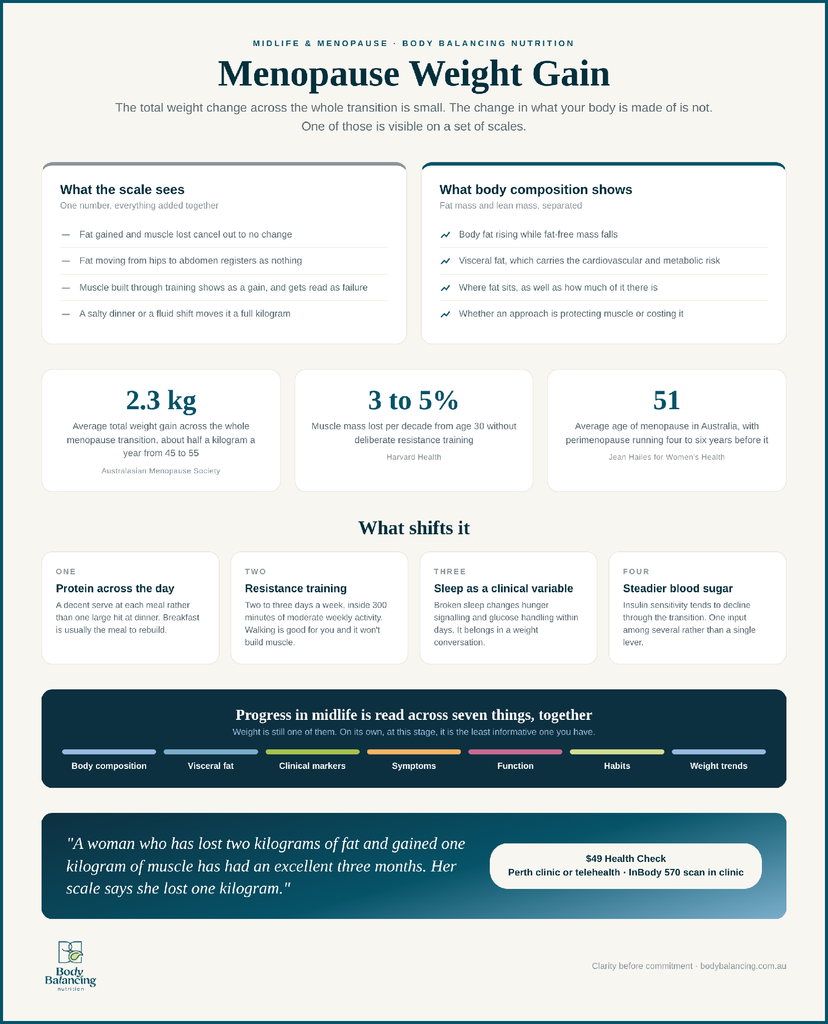
Infographic, published with the article
By the time most women start paying attention to their muscle, they’ve been losing it for fifteen years. Harvard Health reports losses of as much as 3 to 5 per cent per decade from age 30 onward without deliberate resistance training. Add the menopause transition on top, with its own reduction in fat-free mass, and two forces push in the same direction for years.
Muscle is the tissue that sets your daily energy use, holds your bone loading, handles your blood glucose and determines what you can physically do at 70. Losing it lowers the ceiling on everything else you try.
Which is what makes the standard response so costly. Cutting calories hard, without enough protein and without resistance work, takes muscle along with the fat. The weight comes off. So does some of the machinery. Six months later the same deficit stops producing results, and the obvious conclusion is to cut further. Most of the women who walk into our clinic are three or four rounds into that loop and have concluded the problem is their willpower.
Four things carry most of the result, and none of them are new or exciting.
Protein spread across the day. Muscle protein synthesis in midlife responds better to a decent serve at each meal than to one large hit at dinner. For most women that means rebuilding breakfast, which has usually been eroded down to a coffee over about fifteen years.
Resistance training two to three days a week. The Australasian Menopause Society recommends weight-bearing and resistance work on two to three days per week for muscle strength and bone health, and 300 minutes of moderate activity weekly where the goal includes weight management, up from the 150 minutes recommended for general health. Walking is good for you but it won’t build muscle. You need load.
Sleep, treated as a clinical variable rather than a lifestyle wish. Broken sleep changes hunger signalling and glucose handling within days. Waking at 3am is one of the most common things women report through this stage, and it belongs in a weight conversation instead of being filed separately.
Steadier blood sugar. Insulin sensitivity tends to decline across the transition, which changes how your body handles carbohydrate and how hard hunger lands between meals. One input among several rather than a single lever.
Most women arrive having already changed something. The issue is usually which thing.
| Common response | What it costs you | Better use of the same effort |
| Cutting calories harder | Muscle, alongside the fat | Holding intake steady and lifting protein at breakfast |
| Adding more walking or cardio | Time, with little change to lean mass | Two resistance sessions, keeping the walking |
| Weighing daily for accountability | Confidence, on the days it lies to you | Weighing weekly and scanning composition quarterly |
| Cutting carbohydrate across the board | Fibre, energy and often sleep quality | Pairing carbohydrate with protein and fibre to steady the response |
| Waiting for symptoms to settle first | Years of muscle you won’t easily rebuild | Starting resistance work now, at whatever load you can manage |
*Pro Tip:* *If you’re on prescribed weight-loss medication, or considering it, the protein and resistance training pieces matter more rather than less. Appetite drops, intake drops, and muscle is the first thing to go if nutrition isn’t deliberately managed alongside it. That’s a conversation to have with your prescribing practitioner and with a nutrition practitioner, together.
At Body Balancing Nutrition we work the whole picture through what we call the BBN Bridge: Biology (hormones, metabolic health, gut, age), Brain (beliefs, stress, identity), Body (nutrition, movement, sleep) and Behaviour (habits, environment, routine). No single lever explains every woman, which is why the appropriate practitioner assesses each one individually rather than handing out the same protocol to everyone who walks in.
This comes up in nearly every consult, usually phrased as a worry rather than a question. The Australasian Menopause Society is clear that menopausal hormone therapy doesn’t cause weight gain, and there’s evidence it reduces the accumulation of visceral fat after menopause.
Prescribing sits with your doctor, and it should. What tends to get lost is that hormone therapy and nutrition are working on different parts of the problem. Therapy can address symptoms and some of the fat redistribution. It doesn’t feed you enough protein, and it won’t load your skeleton.
Women on hormone therapy still lose muscle when the nutrition side goes unmanaged.
Most women have never been shown anything about their body other than a weight. So the starting point is a wider set of signals, read together rather than one at a time.
Here’s what we look at:
Weight is still on that list. It’s one signal, not the signal, and it’s the least informative one on its own at this stage of life.
> A woman who has lost two kilograms of fat and gained one kilogram of muscle has had an excellent three months. Her scale says she lost one kilogram. Read that number alone and she’d conclude the whole thing failed.
Something worth naming here, because it comes up in nearly every consult: women apologise to us for a 400 gram gain. They arrive with a number they’ve been carrying around as evidence of a personal failing, and it’s usually a Tuesday, or a salty dinner, or the week before a period. The reassurance isn’t the useful part. The composition data is, because it ends the argument.
Some change in body composition through this stage is close to universal. Gaining a significant amount of weight isn’t. The average of half a kilogram a year is a population average, not a prescription, and it reflects what happens by default rather than what has to happen. Women who hold their muscle through resistance training and adequate protein tend to hold their composition far better than women who respond by eating less.
Falling oestrogen changes where your body stores fat, moving it toward abdominal, central and visceral deposits rather than hips and thighs. This happens even when total weight stays stable, which is why so many women describe a shape change without a number change. Visceral fat is also the deposit most associated with cardiovascular and metabolic risk, so it’s worth measuring rather than guessing at.
You can, and waiting is expensive. Perimenopause runs four to six years on average and menopause itself is a single point in time rather than a phase, so waiting for it to pass can mean several years of muscle loss you would then have to rebuild. Starting resistance training and increasing protein intake now protects the tissue that makes everything afterwards easier.
You often can’t tell from symptoms alone. As one woman put it, “I can’t work out if this is peri or some other issue?” [r/Perimenopause, Apr 2026]. Menopause overlaps with thyroid conditions, iron deficiency, insulin resistance and ordinary ageing, and more than one can be present at once. Your GP investigates the medical side. The nutrition, metabolic and body composition layer is what we look at, alongside them.
The Australasian Menopause Society states that menopausal hormone therapy doesn’t cause weight gain, and that there’s evidence it can reduce the accumulation of visceral fat after menopause. Prescribing decisions sit with your doctor. Body Balancing Nutrition provides the nutrition and body composition support, whether or not you’re taking it.
Worth investigating properly rather than pushing harder into the same approach. Weight can sit flat while composition improves, and it can sit flat for reasons that have nothing to do with your effort. Composition data, symptoms, energy and function read together will tell you far more in twenty minutes than the scale has told you in six months.
Enough at each meal to trigger muscle protein synthesis, rather than one large serve at dinner, and the specific amount depends on your body size, your activity and your clinical picture. That’s a number worth having calculated for you rather than guessed at, which is part of what a body composition scan is for.
The short version, if you read nothing else on this page.
| Point | Details |
| The weight change is smaller than it feels | Around 2.3 kg on average across the whole transition, roughly half a kilogram a year between 45 and 55 |
| The composition change is the real story | Body fat rises while fat-free mass falls, and the two partly cancel out on the scale |
| Location is a clinical issue | Falling oestrogen shifts fat toward abdominal and visceral deposits, which carry cardiovascular and metabolic risk |
| Muscle is the tissue to protect | Losses of 3 to 5 per cent per decade from age 30 without resistance training, compounded by the transition |
| Eating less is the costly response | An aggressive deficit without adequate protein and resistance work takes muscle along with fat |
| What BBN offers | A $49 Health Check with Maria, our owner and Health Coach, in the Perth clinic or by telehealth, to work out what your history, habits and body composition are pointing at before you commit to anything |
Most advice on this topic is written for a body that responds the way yours did at 32. Eat less, move more, be patient. That advice assumes your muscle mass is stable, your sleep is intact and your insulin sensitivity hasn’t shifted, and by your late forties at least one of those assumptions has usually stopped holding. Applied to a body mid-transition, the same instruction quietly costs you the tissue you most need to keep.
The second problem is that the advice arrives without measurement. You’re told to lose weight and handed a scale, which is the one tool that can’t see the change you’re trying to make. Then you’re told your bloods are normal, which is often true and rarely the whole answer. The gap between “your results are fine” and “I feel fine” is where most of these women live, and it’s a nutrition and body composition gap rather than a medical one. It’s also why so many women end up assembling their own protocol from peer forums at midnight, which produces exactly the frustration behind one woman’s post: “WE SHOULD NOT HAVE TO LEARN ABOUT THIS HORROR SHOW ON REDDIT!!!” [r/Perimenopause, Apr 2026].
We’re a clinical nutrition practice in West Perth working with midlife women on weight loss and weight management, in the clinic and by telehealth across Australia. Our team is nutritionists, clinical nutritionists and Accredited Practising Dietitians, and the appropriate practitioner assesses your nutrition, metabolic health, body composition, gut health, lifestyle and behaviour individually. We work alongside your GP and any prescribing practitioner, not instead of them.
The starting point is a $49 Health Check with Maria, our owner and Health Coach. It’s a strategy session rather than a clinical consultation, and its job is to work out what’s going on before anyone recommends anything.
The scale can’t tell you whether the change is muscle, body fat, fluid or a combination of all three. It can’t tell you why your clothes fit differently when the number has barely moved. And it can’t tell you what deserves attention first.
That is what our $49 Health Check is for.
Every BBN client starts with a private 45-minute appointment with Maria, our owner and Health Coach. Together, you will look at your symptoms, health and weight history, sleep, energy, eating patterns, movement and what you have already tried.
At our Perth clinic, your appointment includes an InBody 570 body composition scan. This allows us to look at muscle, body fat and fluid separately, rather than averaging everything into one number.
You will leave with a clearer understanding of:
You won’t be handed a generic plan or pressured to sign up for anything. The Health Check is designed to help you understand your starting point before you spend more time, money and effort on an approach that may not fit.
Telehealth appointments include the same detailed review of your symptoms, history and priorities, without the body composition scan.
45 minutes. $49. Measure, don’t guess.
This article provides general nutrition information rather than individual clinical advice. Speak with your GP or an appropriately qualified practitioner about your own situation.
Kickstart Your Journey to Better Health with Our Balanced Health Blueprint Consult – $49 (valued at $139)