Same breakfast, same walk, same portions as five years ago. The clothes stopped fitting anyway.
Metabolism after 40 does not fall off a cliff. When researchers measured total daily energy use in more than 6,400 people across 29 countries, energy expenditure adjusted for body size held steady from about age 20 to age 60, then declined by roughly 0.7 per cent a year after that (Pontzer and colleagues, Science, 2021). What shifts in your forties and fifties is what your body is made of. Muscle drifts down by as much as 3 to 5 per cent per decade from age 30 without resistance training (Harvard Health, 2016). As oestrogen falls, body fat rises, fat-free mass drops, and storage moves toward the abdomen (Australasian Menopause Society, 2018). Sleep fragments, and appetite signalling changes within days. The engine speed is largely intact. The engine is smaller, and that part responds to what you eat and how you train.
Three numbers worth carrying with you:
If you do one thing this week, put a real serve of protein at breakfast. It is the meal where most women lose their daily total.
Not in the way the phrase suggests, and not on the timeline most women have been given.
The largest study of its kind, published in Science in 2021 by Pontzer and colleagues, tracked total daily energy expenditure in more than 6,400 people aged from eight days to 95 years, across 29 countries. Once the researchers adjusted for body size and composition, energy use settled by about age 20 and held flat until age 60, declining at roughly 0.7 per cent a year after that. On that data, a 45-year-old and a 25-year-old of the same size and the same muscle mass burn close to the same amount.
That finding lands badly, because it contradicts what every woman over 40 has been told, and what she has watched happen to her own weight and energy.
Both hold, and the resolution sits in the phrase ‘adjusted for body size and composition’. Metabolic rate per kilogram of lean tissue holds up. The amount of lean tissue does not. Take four kilograms of muscle off a woman between 40 and 55, an ordinary decade and a half without resistance training, and her daily burn falls with nothing having gone wrong with her metabolism at all.
Metabolism after 40 is less a slowing engine than a shrinking one, and the two have different answers. One asks you to eat less. The other asks you to keep the tissue. It also reframes the question of how to speed up metabolism after 40. The lever that matters is the amount of muscle you carry.
Several things move at once, and each of them gets blamed for the others.
The Australasian Menopause Society (2018) puts average weight gain across the transition at about 2.3 kilograms, roughly half a kilogram a year between 45 and 55, and attributes much of that to ageing rather than to menopause. What menopause changes more reliably is composition and distribution: body fat up, fat-free mass down, storage shifting from hips and thighs toward the abdomen as oestrogen falls. Those two partly cancel out on a set of scales, which is why a woman can watch her shape change for two years while her weight moves three kilograms.
What is moving underneath, and what each part responds to:
| What changes after 40 | What it does to your daily energy use | What moves it |
|---|---|---|
| Muscle drops 3 to 5 per cent per decade from 30 without resistance training | Lowers the tissue doing most of your resting burn | Resistance training and enough protein to support it |
| Oestrogen falls through perimenopause | Shifts fat storage toward abdominal and visceral deposits | Composition work, not location-specific exercise |
| Insulin sensitivity tends to decline | Changes how a meal is handled, not how much you burn | Meal structure, fibre, protein, movement after eating |
| Sleep fragments, often for years | Changes appetite signalling and glucose handling within days | Treating sleep as a clinical variable |
| Incidental movement quietly falls | Takes a few hundred calories a day out without a decision | Steps, standing, and noticing where the hour went |
| Repeated dieting | Lowers output beyond what tissue loss predicts, and takes muscle | Eating enough, for long enough, to rebuild |
One row on that list is answered by eating less, and it is the row eating less makes worse.
Pro Tip: If you want one home measurement that tracks composition better than your scales, take your waist at the navel, same time of day, once a fortnight. It moves when visceral fat moves, and holds still when your weight bounces on fluid and salt.
Because it is the tissue that sets your daily energy use, and it is the one you can lose without noticing for fifteen years.
Muscle handles your blood glucose, loads your bones, and decides what you can physically do at 75. Harvard Health (2016) puts the loss at as much as 3 to 5 per cent per decade from age 30 without deliberate resistance training. Layer the menopause transition on top, with its own drop in fat-free mass, and two forces push the same direction for years without either announcing itself.
Which is what makes the standard response expensive. Cut hard, skip the protein, skip the weights, and the weight comes off along with a share of the tissue you needed. Six months later the same deficit produces nothing, and the obvious conclusion is to cut further. The size of that adaptive drop is set out in Metabolism Slowing Down Weight Loss. Most of the women who sit down with us are three or four rounds into that pattern and have decided the problem is their discipline.
A woman who has lost three kilograms of fat and held every gram of her muscle has had a better six months than a woman who has lost five kilograms, two of which were muscle. Her scales rank those two women the other way around.
The infographic below sets out what changes after 40, the numbers behind each part, and what shifts them.
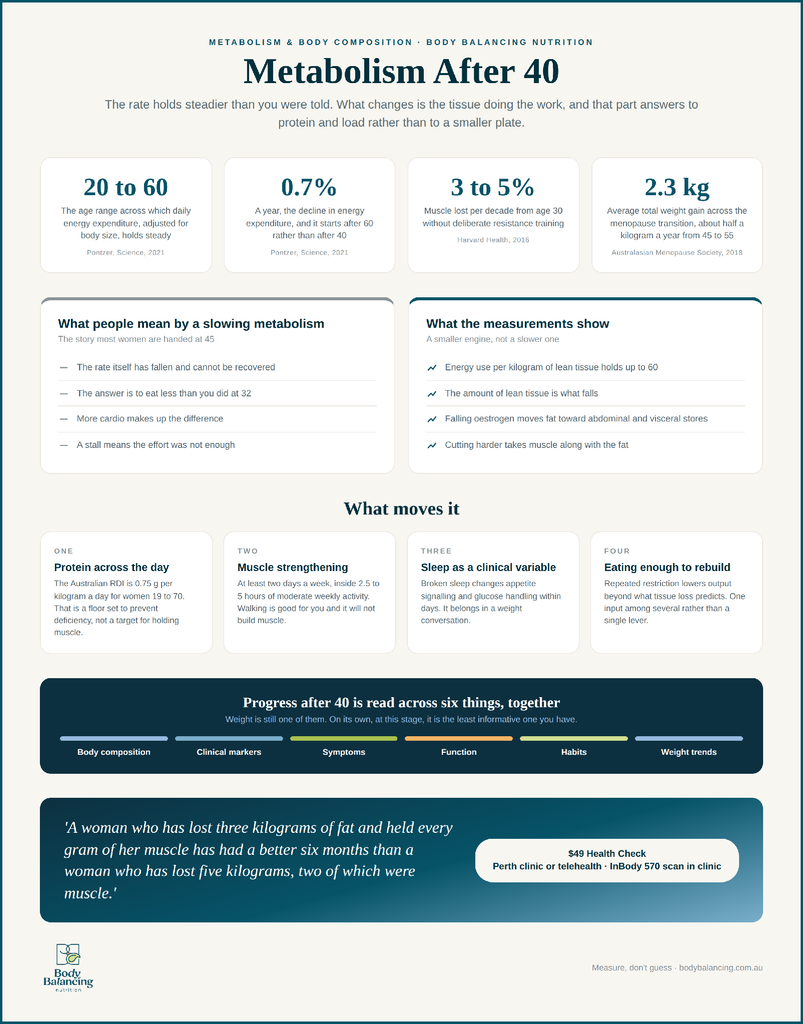
Infographic. Alt text: Infographic on metabolism after 40 showing energy expenditure holding steady from age 20 to 60, muscle loss of 3 to 5 per cent per decade from age 30, average weight gain of 2.3 kilograms across the menopause transition, and the Australian protein RDI of 0.75 grams per kilogram a day.
The Nutrient Reference Values for Australia and New Zealand (NHMRC, 2006) set the RDI for women aged 19 to 70 at 0.75 grams of protein per kilogram of body weight a day, rising to 0.94 grams for women over 70. For a woman of 70 kilograms that is about 53 grams. Those values were set to prevent deficiency across a population, not as a target for a woman in an energy deficit trying to hold her lean mass, and the research on preserving muscle during weight loss generally works well above the RDI.
What suits you depends on your body size, kidney function, medications and what else is going on clinically, which is a conversation for a practitioner rather than a number from a blog. What is safe to say generally: most of the women we see are eating under the RDI before we start, and nearly all of them eat most of their protein after 6pm.
Distribution matters as much as the total. A day of toast, a coffee, a sandwich and then 60 grams of protein at dinner fires the tissue-building signal once. The same total across three meals fires it three times.
Pro Tip: Breakfast is where the daily total goes missing, not dinner. Two eggs, a tub of Greek yoghurt, or last night’s meat eaten cold, moves the number for most women.
Australia’s current physical activity guidelines for adults aged 18 to 64 (Department of Health, Disability and Ageing) ask for 2.5 to 5 hours of moderate activity a week, or 1.25 to 2.5 hours of vigorous activity, plus muscle strengthening on at least two days each week. That second half is the part that gets dropped, and it is the part doing the metabolic work after 40.
Walking is good for you. It will not build the tissue you are trying to protect.
Progressive resistance training means the load goes up over time. Same six exercises, slightly heavier, for months. No gym membership needed, and no hour a day. What it does need is enough load to be hard by the last two repetitions, and enough consistency that your body has a reason to keep the muscle.
Cardiovascular fitness is one of the better predictors of how the next thirty years go, and a woman who walks daily is doing something valuable for her heart, mood and blood glucose. What walking will not do is build the tissue that sets your resting energy use. Adding cardio in response to a plateau is the most common response we see, usually alongside a further cut in food, and that combination takes muscle fastest.
Pro Tip: If you have twenty minutes twice a week and nothing else, spend it on the heaviest lower body work you can do safely, not on the treadmill. Your legs carry the most muscle, so that is where the return sits.
Two of the biggest inputs into metabolism after 40 never show up in a food diary.
Broken sleep changes appetite signalling and glucose handling within days, not months. Women in perimenopause describe it precisely. One put it as ‘Brain fog and insomnia is brutal, like I never sleep and can’t remember things’ (r/Perimenopause, April 2026). A woman on four broken hours makes different food decisions at 4pm and trains at lower intensity if she trains at all. None of that is a discipline problem.
Chronic stress adds a second layer, holding fluid that hides fat loss on the scales for weeks and prompts a further cut in food. We raise both early in consults, because they change what we recommend first. Adding a harder plan to a woman sleeping four hours a night tends to produce a fortnight of compliance and then a collapse she blames on herself.
Jean Hailes for Women’s Health (2026) puts the average age of natural menopause in Australia at 51, with perimenopause usually starting around 47 and running four to six years on average. A long stretch of physiological change rather than a switch, which is why so many women describe the shift as something that crept up on them.
Through that stretch, falling oestrogen moves fat storage toward abdominal and visceral deposits. Visceral fat sits around the organs and behaves differently from the fat under your skin, which is why the Australasian Menopause Society links that pattern to metabolic conditions including cardiovascular disease and diabetes. Same woman, same weight, different distribution, different clinical picture. That pattern is covered in more detail in Menopause Weight Gain: The Complete Guide for Women Over 40.
Prescribed weight-loss medication is part of this conversation for a lot of women now. Medication in the GLP-1 class lowers appetite substantially, so intake can drop below the point where protein and micronutrients are adequate. Rapid loss without enough protein and without resistance training takes lean mass along with fat. BBN does not prescribe, supply or promote medication. Where a woman is using it, the nutrition and body composition side is our work and the prescribing stays with her doctor.
The response that feels obvious after a stall is another cut. What tends to be more useful, matched against what women try first:
| The usual response | What to do instead | Why |
|---|---|---|
| Cut another 300 calories | Hold intake, raise protein, add two resistance sessions | The tissue you are losing sets your burn |
| Add a fourth cardio session | Swap one cardio session for weights | Cardio does not build the muscle that changes resting energy use |
| Weigh daily, adjust weekly | Weigh weekly if at all, track waist and strength fortnightly | Daily weight measures fluid, salt and cycle timing more than fat |
| Cut carbohydrates further | Move carbohydrates toward the meals around training | Fuelling training protects the muscle it is meant to build |
| Push through on four hours of sleep | Work on sleep first | Appetite and glucose handling shift within days of poor sleep |
Few women arrive at this list on their own, because all of it runs against the instinct that got results at 32.
Six weeks in, with a stable scale weight, most women conclude they have wasted six weeks. Often the six weeks did more than the number suggests.
Progress after 40 is read across body composition, clinical markers, symptoms, function, habits and weight trends together. Any one alone will mislead you in the first three months.
| What you are looking at | What good progress looks like | What the scales report |
|---|---|---|
| Body composition | Fat mass down, lean mass held or up | Little or no change |
| Visceral fat | Rating down, waist down a few centimetres | Nothing |
| Strength | Same six exercises, heavier, for more repetitions | Sometimes a small gain, read as failure |
| Symptoms | Fewer afternoon crashes, steadier appetite, better sleep | Nothing |
| Function | Stairs, groceries, getting off the floor | Nothing |
| Weight trend | A gentle downward line across eight weeks | A number that moves a kilogram either way overnight |
Rows one and three are what make women quit approaches that are working. We warn people about both before they start, because being told in advance that the scales will mislead you in week three is often the difference between continuing and deciding you have failed again.
No. Studies of progressive resistance training in older adults, including women well past menopause, consistently show gains in strength and lean mass. The rate is slower than at 25 and the direction is the same. Starting at 55 beats starting at 60.
Muscle is denser than fat, so losing two kilograms of muscle and gaining two of fat reads as no change on the scales while your shape, strength and resting energy use all move. That swap is close to what a lot of women live through across a menopause transition.
Worth raising with your GP, particularly if fatigue, cold intolerance, hair changes and weight change arrived together. Thyroid conditions are more common in women and more common with age. A normal result does not close the picture, and it rules out one real possibility.
A question for your prescribing doctor, and the Australasian Menopause Society is the best plain-language reading before that appointment. From the nutrition side, hormone therapy does not remove the need for protein and resistance training.
Strength usually moves first, inside three to four weeks, ahead of body composition. Composition changes are generally measurable at eight to twelve weeks. Weight is the slowest and noisiest, which makes it a poor thing to judge the first month by.
The short version, if you read nothing else on this page.
| Point | Details |
|---|---|
| The rate is mostly intact | Energy expenditure adjusted for body size holds steady from about 20 to 60, then falls around 0.7 per cent a year (Pontzer, Science, 2021) |
| The tissue is what changes | Muscle drops 3 to 5 per cent per decade from 30 without resistance training, and menopause adds its own drop in fat-free mass |
| Location matters clinically | Falling oestrogen moves fat toward abdominal and visceral deposits, which carry cardiovascular and metabolic risk |
| Protein is a floor, not a target | The Australian RDI of 0.75 g/kg/day for women 19 to 70 (NHMRC, 2006) was set to prevent deficiency, not to hold muscle in a deficit |
| Training is the missed lever | Muscle strengthening on at least two days a week sits in the national guidelines and is the part usually dropped |
| Eating less again is costly | It takes lean mass along with fat, which lowers the burn you were trying to raise |
| What BBN offers | A $49 Health Check with Maria, our owner and Health Coach, in the Perth clinic or by telehealth, to work out what your history, habits and body composition are pointing at before you commit to anything |
The advice almost every woman gets at this point is to eat a bit less and move a bit more. Cut 300 calories, add three walks, be patient.
That advice was right about something real. It addresses Body, the nutrition, movement and sleep layer, and intake and output do both matter. Women who follow it usually lose weight for a while, which is why it keeps getting repeated. It was incomplete rather than incorrect.
What it never touched is the other three quarters. It said nothing about Biology, so it did not account for muscle drifting down, oestrogen moving fat to the abdomen, or the insulin sensitivity change that alters how a meal is handled. It said nothing about Brain, so a woman four attempts in brings a set of beliefs about her own discipline into the fifth, and that shapes what she does at 4pm on a bad day. It said nothing about Behaviour, so the plan holds through a good fortnight and disappears in a bad one, with no architecture underneath it, only effort.
That is the Bridge we work across, in that order: Biology, Brain, Body, Behaviour. Most plans address one of the four properly, and the plateau is what it looks like when the other three go unattended. It also explains the pattern one woman described after two years of adjustments, where each new thing brought relief ‘within 3 to 5 days’ and then faded (r/Menopause, April 2026).
We are a clinical nutrition practice in West Perth working with midlife women on weight loss and weight management, in the clinic and by telehealth across Australia. Our team is nutritionists, clinical nutritionists and Accredited Practising Dietitians, and the appropriate practitioner assesses nutrition, metabolic health, body composition, gut health, lifestyle and behaviour individually. There is no single lever we apply to everyone, and we work alongside your GP and any prescribing practitioner rather than instead of them.
On this topic the work is measurement first. At the Perth clinic we use an InBody 570 body composition scan to separate muscle, body fat and fluid, because setting a protein target from a scale weight is guesswork. Around two in three Australian adults, 67 per cent, were living with overweight or obesity in 2022 to 2024 (AIHW, 2026), and a large share of those women have been given the same advice repeatedly without anyone measuring what their body was made of.
The starting point is a $49 Health Check with Maria, our owner and Health Coach. It is not a clinical, dietitian or nutrition consultation, and it does not produce a diagnosis, a meal plan or a clinical recommendation on the day.
Two women the same age, the same weight and the same daily calories can carry completely different amounts of muscle underneath, and the next twelve months will not look the same for both of them. From the outside, and from a set of bathroom scales, those two women are indistinguishable. That is also why more effort is rarely the thing that changes the result here.
That is what our $49 Health Check is for.
Every BBN client starts with a private 45-minute appointment with Maria, our owner and Health Coach. Together, you will look at your symptoms, health and weight history, sleep, energy, eating patterns, movement and what you have already tried.
At our Perth clinic, your appointment includes an InBody 570 body composition scan. This allows us to look at muscle, body fat and fluid separately, rather than averaging everything into one number.
You will leave with a clearer understanding of:
You won’t be handed a generic plan or pressured to sign up for anything. The Health Check is designed to help you understand your starting point before you spend more time, money and effort on an approach that may not fit.
Telehealth appointments include the same detailed review of your symptoms, history and priorities, without the body composition scan.
45 minutes. $49. Measure, don’t guess.
1. Total daily energy expenditure adjusted for body size holds steady from about age 20 to age 60, then declines by roughly 0.7 per cent a year; measured in more than 6,400 people aged eight days to 95 years across 29 countries – Pontzer H and colleagues, Daily energy expenditure through the human life course, Science, 2021 – https://www.science.org/doi/10.1126/science.abe5017
2. Muscle mass is lost at as much as 3 to 5 per cent per decade from age 30 without deliberate resistance training – Harvard Health Publishing, Preserve your muscle mass, 2016 – https://www.health.harvard.edu/staying-healthy/preserve-your-muscle-mass
3. Women gain on average half a kilogram a year between the ages of 45 and 55, and a total of 2.3 kg across the menopause transition – Australasian Menopause Society, Weight management and healthy ageing, 2018 – https://www.menopause.org.au/hp/information-sheets/weight-management-and-healthy-ageing
4. Menopause increases body fat and at the same time decreases fat-free body mass – Australasian Menopause Society, Weight management and healthy ageing, 2018 – https://www.menopause.org.au/hp/information-sheets/weight-management-and-healthy-ageing
5. Increased body fat is laid down preferentially in abdominal, central and visceral deposits, which are associated with metabolic conditions such as cardiovascular disease and diabetes – Australasian Menopause Society, Weight management and healthy ageing, 2018 – https://www.menopause.org.au/hp/information-sheets/weight-management-and-healthy-ageing
6. Protein RDI for women aged 19 to 70 is 0.75 g per kg of body weight a day, rising to 0.94 g per kg for women over 70 – NHMRC and New Zealand Ministry of Health, Nutrient Reference Values for Australia and New Zealand, 2006 – https://www.eatforhealth.gov.au/nutrient-reference-values/nutrients/protein
7. Adults aged 18 to 64 should do 2.5 to 5 hours of moderate intensity activity or 1.25 to 2.5 hours of vigorous activity each week, plus muscle strengthening on at least 2 days each week – Australian Government Department of Health, Disability and Ageing, physical activity and exercise guidelines for adults 18 to 64, current guidelines, accessed September 2026 – https://www.health.gov.au/topics/physical-activity-and-exercise/physical-activity-and-exercise-guidelines-for-all-australians/for-adults-18-to-64-years
8. The average age of natural menopause in Australia is 51; perimenopause usually starts around 47 and lasts 4 to 6 years on average – Jean Hailes for Women’s Health, Menopause, 2026 – https://www.jeanhailes.org.au/health-topics/menopause
9. In 2022 to 2024, around 2 in 3 Australian adults (67 per cent) were living with overweight or obesity – Australian Institute of Health and Welfare, Overweight and obesity, 2026 – https://www.aihw.gov.au/reports/overweight-obesity/overweight-and-obesity
Kickstart Your Journey to Better Health with Our Balanced Health Blueprint Consult – $49 (valued at $139)