You’ve lost the same eight kilograms three times. The last round was the strictest of the three and it barely moved anything.
Sustainable weight loss is weight loss that holds after the effort of losing it stops, and what decides whether it holds is how many things were addressed at the same time. After 40, four things change more or less at once: your Biology, your Brain, your Body and your Behaviour. Most plans work on one of them. Cut carbohydrates, and you’ve worked on Body. Address your mindset, and you’ve worked on Brain. Each of those can produce a real result for six or eight weeks, which is exactly why women keep trying them. The result stops holding when the three untouched pillars pull the other way. That is the argument this guide makes, and the framework behind it is what we call the BBN Bridge.
Three numbers worth carrying with you:
If you do one thing this week, work out which of the four pillars your last attempt covered, and which three it left alone.
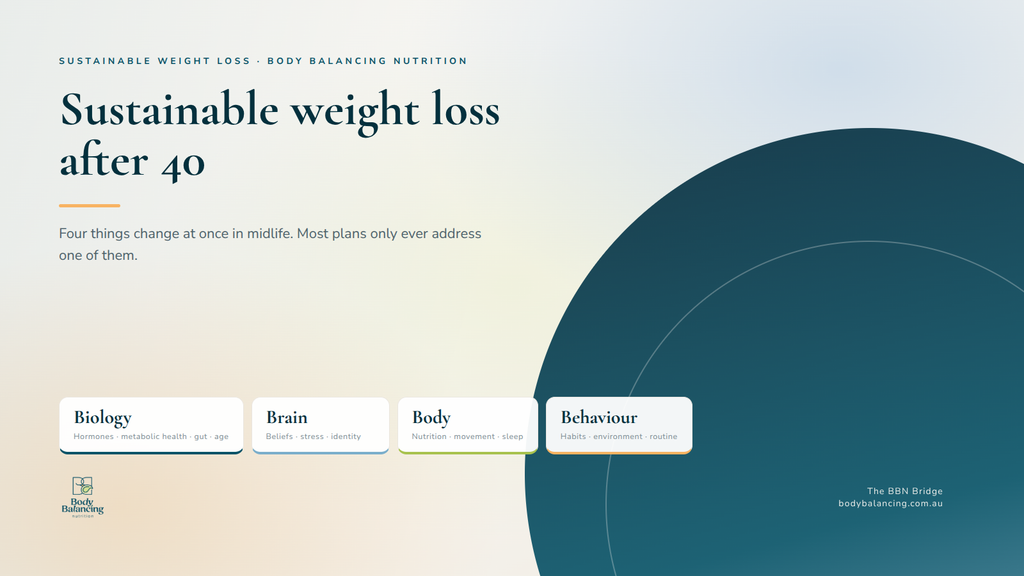
The BBN Bridge hero graphic, naming the four pillars Biology, Brain, Body and Behaviour in Body Balancing Nutrition brand colours
Sustainable weight loss is the version that survives contact with an ordinary week.
Losing weight is a project. It has a start date, a set of rules, and an end you’re working toward. Sustainable weight loss has none of that structure, because it has to keep working through a head cold, a fortnight of school holidays, a bad run of sleep and the week your mother goes into hospital. Anything that only holds while conditions are perfect is a result you’re renting.
The clinical target is smaller than most women expect. The Australian Institute of Health and Welfare reports that 65.8 per cent of Australian adults were living with overweight or obesity in 2022, drawing on the ABS National Health Survey, so this is close to the default experience rather than a personal anomaly. And the National Health and Medical Research Council guidelines put clinically meaningful benefit at a 5 to 10 per cent reduction in body weight, which is where blood pressure, blood lipids and blood glucose start to improve. For a woman of 85 kilograms that’s between four and eight and a half kilograms. Held.
Most of the women we see have lost far more than that, several times. The losing was never the problem.
Because the conditions that produced the loss were temporary, and so was the loss.
Think about what a typical round looks like. Intake drops sharply. Movement goes up. For six or eight weeks it works, because a large enough deficit will move the scale on almost anyone. Then somewhere around week nine, a few things happen together. Hunger stops being manageable. Sleep gets worse, so appetite regulation gets worse. Muscle has come off alongside the fat, which lowers the energy you burn at rest, so the same deficit produces less. And the rules that felt clarifying in week two now feel like a second job.
None of that is a failure of character. It’s what happens when one lever gets pulled hard and nothing supports it.
Pro Tip: The week to plan for is week nine, not week one. Almost every approach works in week one. If you can’t describe what your Tuesday looks like in week nine, when you’re tired and behind and something has gone wrong at work, the plan hasn’t been tested yet.
Weight regain also has an information problem sitting underneath it. Most women measure a single number and read it as a verdict on everything, which means a good three months and a poor three months can look identical. More on that below.
Three physiological shifts, running at the same time, on a body that used to respond differently.
Muscle. Fat-free mass declines through midlife, and it accelerates through the menopause transition. Muscle sets a large part of your daily energy use, handles a lot of your blood glucose, and determines what you can physically do at 70. An aggressive deficit without enough protein and without resistance work takes muscle along with the fat. The weight comes off. So does part of the machinery you needed for round two.
Where fat sits. As oestrogen falls, fat storage shifts toward abdominal, central and visceral deposits. The Australasian Menopause Society links that pattern to metabolic conditions including cardiovascular disease and diabetes, which makes it a clinical question rather than a cosmetic one. Same woman, same weight, different risk profile.
Sleep and the load around it. Broken sleep changes hunger signalling and glucose handling within days. Midlife tends to arrive with teenagers, ageing parents and the heaviest years of a career attached to it, and the hour that used to go on moving goes on everything else.
Here’s the part that catches women out. The advice they’re given hasn’t changed to match any of that. Eat less and move more assumes stable muscle mass, intact sleep and unchanged insulin sensitivity. By the late forties at least one of those assumptions has usually stopped holding.
The BBN Bridge is our name for the four things that decide whether weight loss lasts: Biology, Brain, Body and Behaviour, always in that order.
Biology is hormones, metabolic health, gut and age. Brain is beliefs, stress and identity. Body is nutrition, movement and sleep. Behaviour is habits, environment and routine. Four pillars, because after 40 all four move at once and no single one of them explains a whole person.
The reason to name them is practical rather than decorative. When a plan works for eight weeks and then stops, the pillar it addressed was doing its job and the three it ignored eventually outvoted it. Naming which is which turns a vague sense of failure into a specific gap you can do something about.
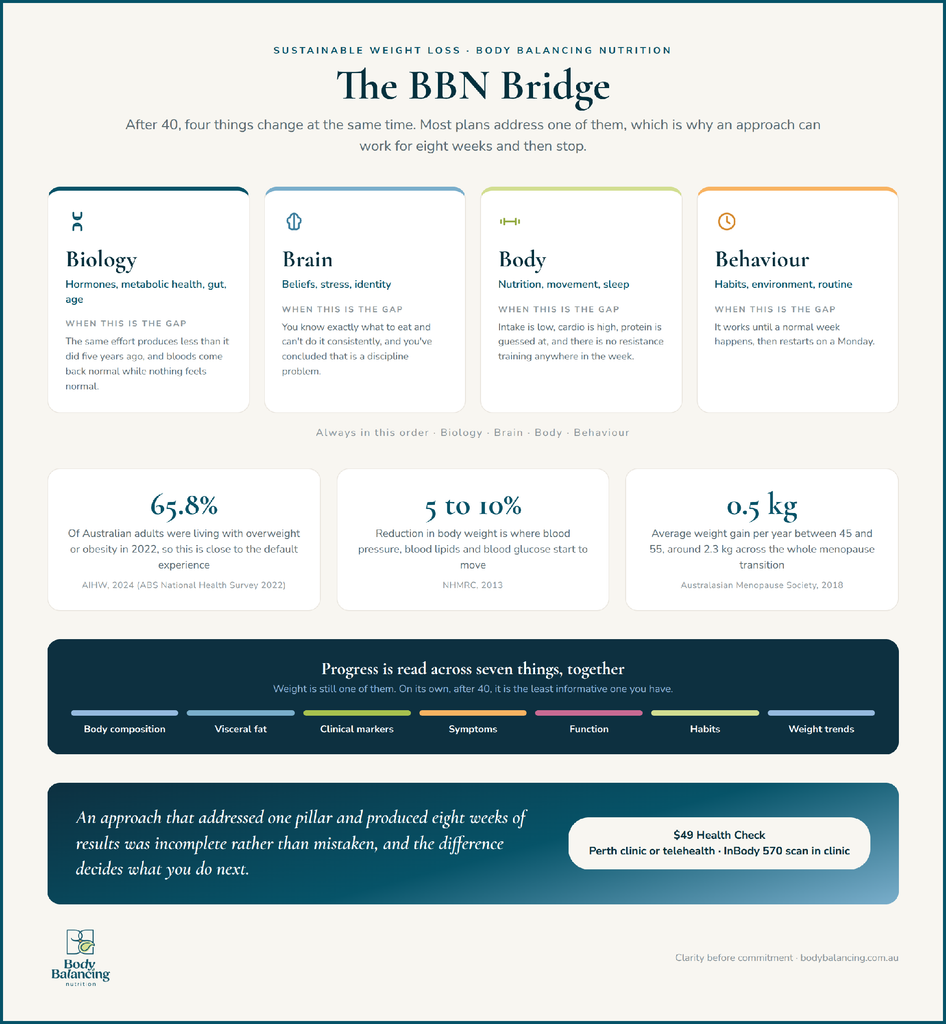
The BBN Bridge, showing the four pillars of Biology, Brain, Body and Behaviour, what each one covers, and what it looks like when a plan leaves one out
The infographic above sets out the four pillars, what each covers, and the signature of an approach that skipped it. The table below does the same job in more detail, because the pattern is usually recognisable once you see it written down.
| Pillar | What it covers | What it looks like when this is the gap |
|---|---|---|
| Biology | Hormones, metabolic health, gut, age | The same effort produces less than it did five years ago, and bloods come back normal while nothing feels normal |
| Brain | Beliefs, stress, identity | You know exactly what to eat and can’t do it consistently, and you’ve concluded that’s a discipline problem |
| Body | Nutrition, movement, sleep | Intake is low, cardio is high, protein is guessed at, and there’s no resistance training anywhere in the week |
| Behaviour | Habits, environment, routine | It works until a normal week happens, then restarts on a Monday |
Read down the last column. Most women recognise two or three of those rows, not one, which is the whole point.
Pro Tip: When a woman tells me a plan worked and then stopped, my first question is what changed in her week just before it stopped. Nine times in ten it wasn’t her food. It was a work trip, a school holiday, a run of bad sleep or a sick parent. That’s Behaviour and Brain, and no amount of adjusting the food will cover for it.
There’s no single answer, which is the honest version of this section rather than the satisfying one.
What we can say is that the pillar most often left out is rarely Body. Almost every woman arriving at our clinic has already changed her food, usually several times, and often with real care. What she hasn’t had is anyone looking at her Biology with real data, or taking seriously what four unsuccessful rounds have done to what she believes about herself.
An approach that addressed one pillar and produced eight weeks of results was incomplete rather than mistaken, and the difference decides what you do next: go looking for what it left out, or go looking for a stricter version of the same thing.
Something we hear in some form most weeks: ‘I’ve spent two years trying things that give me three to five days of relief and then stop working’ [r/Menopause, Apr 2026]. Three to five days is a Body-only response. It’s real, it’s not imaginary, and it fades because nothing underneath it changed.
Less dramatic than you’d think, and more boring than most people want it to be.
The table below sets out the swaps we make most often, which are almost always about redirecting effort rather than adding more of it.
| What she’s already doing | What it costs her | Better use of the same effort |
|---|---|---|
| Cutting intake harder each round | Muscle, alongside the fat, so round four starts with a lower muscle mass and higher body fat percentage than before | Holding intake steady and lifting protein, especially at breakfast |
| Adding more walking or cardio | Time, with little change to lean mass | Two resistance sessions a week, keeping the walking |
| Weighing daily for accountability | Confidence, on the days the number lies | Weighing weekly and reading a four-week trend |
| Starting again every Monday | The middle of the week, every week | Deciding what a 70 per cent week looks like and running that instead |
| Waiting until work settles down | Years of muscle that gets harder to rebuild each year | Starting the smallest version now, at whatever load fits |
| Cutting out a whole food group | Fibre, energy, and often sleep quality | Pairing carbohydrate with protein and fibre to steady the response |
On movement, the Australasian Menopause Society recommends weight-bearing and resistance work on two to three days a week for muscle strength and bone health, plus 300 minutes of moderate activity weekly where the goal includes weight management, up from the 150 minutes recommended for general health. Walking is good for you but it won’t build muscle. You need load.
Protein is the other one worth being specific about. Spread across the day rather than concentrated at dinner, because muscle protein synthesis in midlife responds better to a decent serve at each meal. For most women that means rebuilding breakfast, which has usually eroded down to a coffee over about fifteen years.
The four pillars stay the same. Biology gets louder.
The Australasian Menopause Society puts average weight gain between 45 and 55 at half a kilogram a year, around 2.3 kg across the whole transition, with several studies attributing that gain to ageing rather than to menopause itself. What menopause changes is composition: body fat rises, fat-free mass falls, and the two partly cancel out on the scale. Which is why so many women describe a body they don’t recognise attached to a number that has barely moved.
Practically, three things shift for a midlife woman pursuing sustainable weight loss:
If you want the detail on what’s driving that, our guide to menopause weight gain covers the physiology properly, and perimenopause weight gain covers the earlier stage where most women first notice it.
By reading several signals together instead of one signal repeatedly.
Most women have never been shown anything about their body except a weight. Here’s the wider set we work from:
Weight stays on that list. It’s one signal rather than the signal, and on its own after 40 it’s the least informative one you have.
A woman who has lost two kilograms of fat and gained one kilogram of muscle has had a strong three months. Her scale reports one kilogram down. Read that number by itself and she’d conclude the whole thing was a waste of time, which is roughly what happens in a lot of kitchens on a lot of Monday mornings.
Pro Tip: If you’re on prescribed weight-loss medication, or considering it, the protein and resistance training pieces matter more rather than less. Appetite drops, intake drops, and muscle is the first thing to go when nutrition isn’t managed deliberately alongside it. Worth having that conversation with your prescribing practitioner and a nutrition practitioner together, and our honest look at weight-loss injections versus lifestyle change sets out how the two work side by side.
Longer than a challenge and shorter than forever. Most of the change that matters clinically sits inside a 5 to 10 per cent reduction in body weight, which for many women is a matter of months rather than years. What takes longer is building the routine that holds it, and that part tends to run alongside the losing rather than after it.
The rate matters less than what comes off. A faster loss that takes muscle with it leaves you worse placed than a slower one that protects it, because muscle sets a large part of your daily energy use. That’s a body composition question rather than a speed question, which is why we measure composition rather than guessing from the rate.
No. Cutting a whole food group tends to cost you fibre, energy and often sleep quality, and it addresses a single pillar while leaving three alone. Pairing carbohydrates with protein and fibre steadies the response for most people. If you have a diagnosed condition affecting glucose handling, that’s a conversation for your GP and an appropriately qualified nutrition practitioner.
That question usually belongs to Brain and Behaviour rather than to knowledge. Knowing what to eat and being able to eat that way through a difficult fortnight are different capabilities, and after several unsuccessful rounds most women have quietly concluded the gap is a personal deficiency. It’s more often an environment and stress problem with no plan attached to it.
The principles hold. The Biology pillar looks different, because men don’t go through the menopause transition, so the muscle and fat distribution changes tend to be slower and less abrupt. Our clinical team supports women and men, and the assessment is individual either way.
Worth taking seriously rather than dismissing. Energy, sleep, digestion and strength improving while weight sits flat is a common pattern when composition is changing underneath, and it’s also a pattern that predicts the number moving later. That’s exactly the situation where a body composition measurement earns its keep.
The short version, if you read nothing else on this page.
| Point | Details |
|---|---|
| Sustainable means it survives a bad week | A result that only holds under perfect conditions is one you’re renting |
| The clinical target is smaller than expected | A 5 to 10 per cent reduction is where blood pressure, blood lipids and blood glucose start to move (NHMRC) |
| Four things change at once after 40 | Biology, Brain, Body and Behaviour, and most plans address one of them |
| One pillar buys you about eight weeks | Which is why so many approaches work briefly and then stop |
| Midlife loads the Biology pillar | Half a kilogram a year between 45 and 55 on average, with composition changing more than weight (Australasian Menopause Society) |
| What BBN offers | A $49 Health Check with Maria, our owner and Health Coach, in the Perth clinic or by telehealth, to work out which pillars your situation turns on before you commit to anything |
Eat less and move more. It’s the most common advice on this topic in the country, and it deserves more credit than it usually gets in an article like this one.
It was right about Body. Nutrition and movement are where a large part of the answer lives, the instruction is clear enough to act on, and for most women it produced real results for a decade or more. When a 34-year-old cuts back and starts walking, her weight comes down, because her muscle mass was stable and her sleep was intact and her insulin sensitivity hadn’t shifted. The advice worked because the assumptions underneath it were true at the time.
What it was silent on is the rest of the picture. It says nothing about Biology, so it can’t tell her that the same deficit now takes muscle she can’t easily replace, or that falling oestrogen has moved where fat sits, or that her sleep has been broken for two years. It says nothing about Brain, so it has no answer for what four unsuccessful rounds do to a woman’s confidence in her own consistency, or for the stress load she’s carrying while she attempts round five. And it says nothing about Behaviour, so it has no plan for the week her routine falls apart, which is the week that decides the outcome.
None of it was incorrect. It was incomplete, and incomplete is a different problem with a different solution. Biology, Brain, Body and Behaviour, worked together rather than one at a time, is what the BBN Bridge describes and what we assess for.
We’re a clinical nutrition practice in West Perth working with midlife women on weight loss and weight management, in the clinic and by telehealth across Australia. Our team is nutritionists, clinical nutritionists and Accredited Practising Dietitians, and the appropriate practitioner assesses your nutrition, metabolic health, body composition, gut health, lifestyle and behaviour individually. There’s no single mechanism behind the work and no protocol everyone gets. We work alongside your GP and any prescribing practitioner rather than instead of them.
The Bridge is how we organise that assessment. It’s also how we explain to a woman why the last four things she tried behaved the way they did, which is usually the first time anyone has given her an explanation that isn’t about her willpower.
The starting point is a $49 Health Check with Maria, our owner and Health Coach. It isn’t a clinical, dietitian or nutrition consultation, and its job is to work out what’s going on before anyone recommends anything.
You’ve already worked out what to eat. What’s harder to work out from the outside is why the same effort that produced a result at 34 produces nothing at 47, and which of the four things that changed is costing you the most right now. A scale, a food diary and another six weeks of trying harder won’t separate those out for you.
That is what our $49 Health Check is for.
Every BBN client starts with a private 45-minute appointment with Maria, our owner and Health Coach. Together, you will look at your symptoms, health and weight history, sleep, energy, eating patterns, movement and what you have already tried.
At our Perth clinic, your appointment includes an InBody 570 body composition scan. This allows us to look at muscle, body fat and fluid separately, rather than averaging everything into one number.
You will leave with a clearer understanding of:
You won’t be handed a generic plan or pressured to sign up for anything. The Health Check is designed to help you understand your starting point before you spend more time, money and effort on an approach that may not fit.
Telehealth appointments include the same detailed review of your symptoms, history and priorities, without the body composition scan.
45 minutes. $49. Measure, don’t guess.
1. 65.8 per cent of Australian adults were living with overweight or obesity in 2022
Australian Institute of Health and Welfare, drawing on the ABS National Health Survey 2022, 2024
https://www.aihw.gov.au/reports/overweight-obesity/overweight-and-obesity
2. A 5 to 10 per cent reduction in body weight is where blood pressure, blood lipids and blood glucose show clinically meaningful improvement
National Health and Medical Research Council, Clinical Practice Guidelines for the Management of Overweight and Obesity, 2013
3. Average weight gain of half a kilogram a year between 45 and 55, around 2.3 kg across the whole menopause transition, attributed largely to ageing rather than to menopause itself
Australasian Menopause Society, Weight management and healthy ageing, 2018
https://www.menopause.org.au/hp/information-sheets/weight-management-and-healthy-ageing
4. Menopause raises body fat and lowers fat-free mass at the same time, so composition changes more than total weight does
Australasian Menopause Society, Weight management and healthy ageing, 2018
https://www.menopause.org.au/hp/information-sheets/weight-management-and-healthy-ageing
5. Falling oestrogen shifts fat storage toward abdominal, central and visceral deposits, a pattern linked to metabolic conditions including cardiovascular disease and diabetes
Australasian Menopause Society, Weight management and healthy ageing, 2018
https://www.menopause.org.au/hp/information-sheets/weight-management-and-healthy-ageing
6. Weight-bearing and resistance work on two to three days a week, plus 300 minutes of moderate activity weekly where the goal includes weight management, up from the 150 minutes recommended for general health
Australasian Menopause Society, Weight management and healthy ageing, 2018
https://www.menopause.org.au/hp/information-sheets/weight-management-and-healthy-ageing
This article provides general nutrition information rather than individual clinical advice. Speak with your GP or an appropriately qualified practitioner about your own situation.
Kickstart Your Journey to Better Health with Our Balanced Health Blueprint Consult – $49 (valued at $139)