
The 3pm flatline. A middle that holds on through everything that used to shift it, and bloods that come back normal every time you ask.
Insulin resistance is a reduced response to insulin in the cells that take up glucose, so the pancreas produces more insulin to do the same job. Blood glucose can sit inside the normal range for years while insulin runs high in the background, which is why a routine test can be accurate and unrevealing at the same time. Insulin resistance in women is shaped by three things that arrive together through midlife: falling oestrogen, declining skeletal muscle, and sleep that stops being reliable. Muscle takes up most of the glucose from a meal, so losing it lowers your capacity to remove glucose from the bloodstream after eating. It sits on a spectrum rather than being present or absent, it moves in both directions, and any diagnosis or test interpretation belongs with your GP. Nutrition, muscle and sleep are the levers that shift it, and they work together rather than one at a time.
Three Australian numbers worth carrying with you:
If you do one thing this week, write down what you ate and how you felt two hours afterwards, every day for seven days, then take that page to your GP.
Insulin moves glucose out of your bloodstream and into cells, mostly muscle cells. When those cells respond less readily, the pancreas compensates by making more insulin, and for a long stretch the compensation holds. Blood sugar stays where it should be. Nothing looks wrong on a form.
Underneath, you are getting the same result at a higher cost. Circulating insulin favours storage over release, abdominal storage in particular, and while it stays high the body finds it harder to draw on stored fat for fuel. So a woman can be eating carefully, walking daily and collecting normal results while the biology works quietly against her.
That gap between what a test reports and what a body is doing is why insulin resistance in women so often gets discovered sideways. One woman went to her doctor about hot flushes and came out with a liver result she had not gone looking for: ‘I got the results and my AST and ALT are hi…’ [r/Perimenopause, Apr 2026]. Fatty liver, raised triglycerides, a creeping waist measurement and a borderline blood pressure reading tend to travel together, and they travel with insulin.
| Insulin resistance sits on a spectrum, it moves in both directions, and it starts moving long before a blood test has anything to say about it. |
No single one of these confirms anything. Several together, in a woman in her forties or fifties, is a pattern worth investigating rather than working harder around. The table sets out what women describe in the room and why each shows up. Read the left column as things you might notice, not a checklist.
| What she notices | Why it happens |
|---|---|
| Weight around the middle that stays put | High circulating insulin favours body fat storage, and midlife hormonal change already directs it abdominally |
| A pull towards sugar or bread an hour or two after a meal that should have been satisfying | When the insulin response overshoots, blood glucose falls further than it should and the body asks for the fastest fuel |
| Flat, foggy and heavy-lidded after lunch | Post-meal glucose and insulin swings affect energy and concentration, especially after carbohydrate eaten on its own |
| Skin tags, or velvety darkening at the neck, armpits or groin | Both are associated with high insulin and worth mentioning to a GP |
| A family history of type 2 diabetes, or a past gestational diabetes | Not a symptom. A risk factor, and a reason to look earlier |
Fatigue and fog get dismissed most often, by other people and by the women themselves. ‘My most disruptive symptoms are fatigue and brain fog,’ one woman wrote [r/Menopause, Apr 2026], two years into trying different approaches. Both have a long list of possible causes, and glucose handling is one of the ones checked last.
| Pro Tip: The most useful thing you can take into a GP appointment is a week of written notes. What you ate, when the crash landed, how you slept the night before. A pattern on paper gets a different conversation than ‘I’m tired all the time’. |
The infographic below sets out the Australian numbers, what the common tests can and cannot tell you, and where nutrition fits.
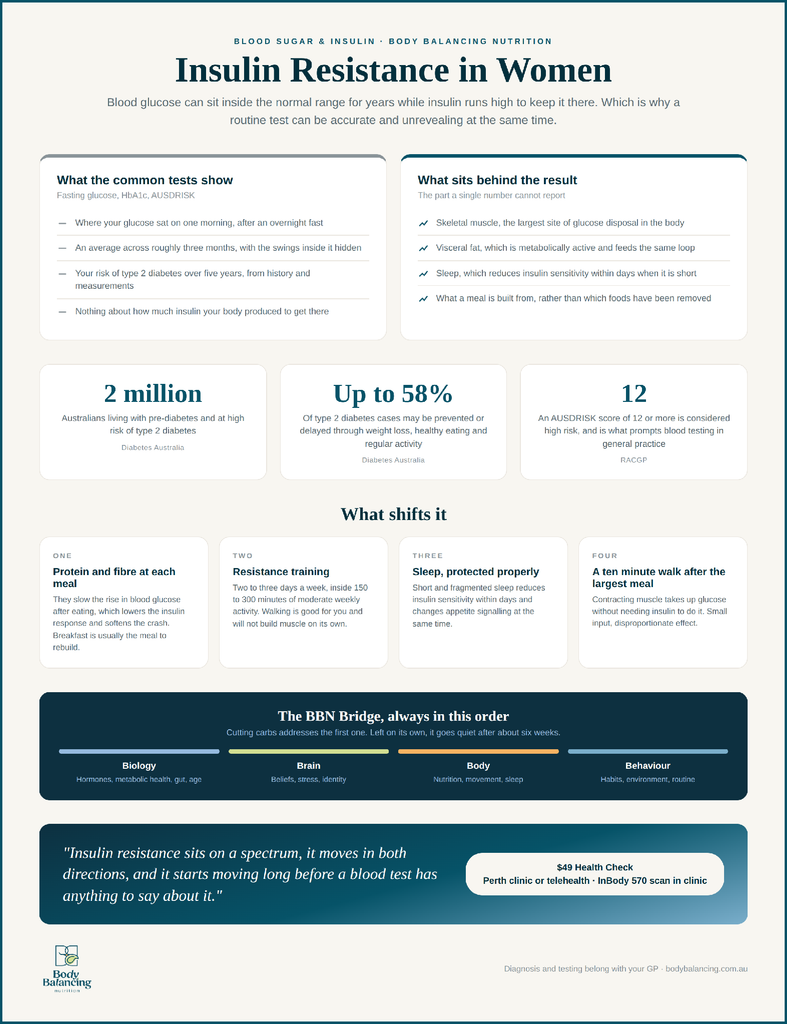
This is where women lose money and time, so it is worth being plain. No single blood test in Australian general practice returns a verdict of insulin resistance. What your GP establishes is where you sit on the glucose spectrum and how much risk you carry. The RACGP handbook for general practice sets out the pathway: an AUSDRISK risk assessment, where a score of 12 or more is high risk, then blood testing with fasting blood glucose or HbA1c. Adults are assessed every three years from age 40, annually where impaired fasting glucose or impaired glucose tolerance is present, and Aboriginal and Torres Strait Islander adults go straight to blood testing from age 18.
Here is what each common test does and does not do.
| Test | What it tells you | What it does not tell you |
|---|---|---|
| Fasting blood glucose | Where your glucose sat after an overnight fast, on that one morning | How much insulin your body produced to get it there |
| HbA1c | An average of your glucose over roughly the previous three months | Anything about insulin, or the swings inside that average |
| Oral glucose tolerance test | How your body handles a measured glucose load over two hours | Nothing about insulin, unless insulin is measured alongside it |
| AUSDRISK questionnaire | Your risk of type 2 diabetes over five years | Whether you have insulin resistance now. A risk tool, not a diagnostic one |
| Fasting insulin, or an index such as HOMA-IR | An estimate of insulin resistance, used mainly in research and specialist settings | It sits outside Australian diagnostic criteria and is not routine in general practice |
| A body composition scan | Muscle mass, body fat and visceral fat, separately | It cannot diagnose insulin resistance, and is no substitute for blood work |
Two things follow from that table. Fasting insulin and HOMA-IR are not the hidden test the internet presents them as. They are real measures and they are used, but reference ranges vary between laboratories, a single fasting sample is a noisy way to estimate a moving quantity, and no Australian diagnostic threshold hangs off them. Whether any of it suits you depends on your history, symptoms and risk, and that judgement belongs with your GP. We cannot order these and we cannot interpret them for you.
A normal result is worth having and is not a clean bill. Glucose is the number that stays normal longest here. If your results are fine and you still feel wrong, the next question is what else is in the picture.
| Pro Tip: Direct-to-consumer insulin panels and finger-prick apps sell certainty they cannot deliver. Take your seven days of notes, your waist measurement and your family history to a GP first, and ask what is worth checking. Some pathology may be eligible for a Medicare rebate, depending on the practitioner, the test, the referral and your circumstances, so ask rather than assume. |
Because several things move at once, and they move the same way.
Falling oestrogen affects insulin sensitivity and, separately, changes where the body puts fat. The Australasian Menopause Society describes the increase in body fat through the menopausal transition as preferentially abdominal, central and visceral, and links that distribution to metabolic conditions including cardiovascular disease and diabetes. Visceral fat is metabolically active tissue sitting around the organs, and it feeds back into the same loop.
Lean muscle drifts downward with age at the same time unless it is deliberately loaded, and less muscle means less capacity to clear a meal. Sleep, for a large proportion of women in their late forties, stops being dependable somewhere around 2am, which affects glucose handling and appetite regulation within days.
So a woman doing nothing different from what she did at 35 can end up with a different response to the same lunch, and conclude she has become lazy. The inputs changed underneath her. One line from a midlife forum captures where most women sit: ‘I can’t work out if this is peri or some other issue?’ [r/Perimenopause, Apr 2026]. It is usually both, doing different jobs.
Closely, and earlier in life than the rest of this guide assumes.
Insulin resistance is a common feature of polycystic ovary syndrome, and it can be present in women across the weight range rather than only in those carrying more body fat. For many, the two have travelled together since their twenties, so they reach perimenopause with a longer history behind them.
The nutrition principles here still apply, but the sequencing differs enough to be worth reading separately, and we have written that up in our PCOS nutrition guide. Diagnosis, monitoring and any medication stay with your GP or specialist.
Not the ones most women expect. What changes post-meal glucose most reliably has less to do with removing foods than with what a meal is built from. Protein and fibre slow the rise in blood glucose after eating, which lowers the insulin response and softens the crash on the other side. A carbohydrate eaten on its own asks far more of the system than the same carbohydrate alongside protein, fat and vegetables. Nothing has to be removed in the first month, and most women notice the mid-afternoon crash soften before they have cut a single thing. Here is what that looks like using meals women actually eat.
| Instead of this | Try this | What changes |
|---|---|---|
| Toast and jam, coffee, out the door | Toast with two eggs, or Greek yoghurt with fruit and nuts | Breakfast is the meal most often built from carbohydrate alone, and sets up the 11am dip |
| A sandwich eaten at the desk with no or a small portion of protein | The same sandwich with tuna or legumes added, and a side salad | More protein and fibre for the same convenience |
| Rice or pasta plated first, protein and veg as an afterthought | Half the plate vegetables, a decent serve of protein, then the rice or pasta | The carbohydrate stays. The order and the amount at a sitting both change |
Wholegrains, legumes, fruit and vegetables all carry fibre and nutrients worth having. Cutting carbohydrates hard produces a quick weight drop, some of it fluid, followed by an eating pattern that cannot be sustained past a few months.
Because skeletal muscle is where most of the glucose from a meal ends up.
Muscle is the largest site of glucose disposal in the body. Less of it means less capacity to take up a meal, and the same food produces a bigger swing. This part of the picture gets almost no attention in standard advice, and it explains why two women eating identically can have different responses.
It also explains why the usual midlife response makes things harder. Eating less, without enough protein and without loading the muscle, takes lean tissue along with the fat. The weight comes off. So does some of the machinery that was handling the glucose. Six months later the same approach stops working, and the obvious conclusion is to cut harder. Most of the women who come to us are three or four rounds into that loop.
The Australasian Menopause Society recommends weight-bearing and resistance work on two to three days a week, inside 150 to 300 minutes of moderate activity. That is the dose. Walking is good for you and will not build muscle on its own.
| Pro Tip: Two sessions a week that you keep will beat four you abandon in March. And the ten minute walk after your largest meal is the highest-return item on this page for the least effort, because contracting muscle takes up glucose without needing insulin to do it. |
More than most women expect, and faster.
Short and fragmented sleep reduces insulin sensitivity within days and changes appetite signalling at the same time, so the day after a bad night is both physiologically and behaviourally harder. Sustained stress raises cortisol, which raises blood glucose, which raises insulin. Neither responds to being told to relax.
A nutrition plan built on top of four months of broken sleep is being asked to do two jobs and will do neither well. When we see a woman who has eaten carefully for a year with nothing to show for it, sleep is one of the first places we look.
It responds well, and for many women the direction of travel changes substantially. How far and how fast depends on where you start, how long it has been running and what else is going on, which is why insulin resistance in women is worth assessing rather than assuming from symptoms.
The Australian evidence on the population version of this question is encouraging. Diabetes Australia reports that around two million Australians have pre-diabetes, that roughly 5 to 10 per cent of them progress to type 2 diabetes each year without sustained change, and that people with impaired glucose metabolism carry a risk of type 2 diabetes 10 to 20 times greater than people with normal blood glucose. It also reports that type 2 diabetes may be prevented or delayed in up to 58 per cent of cases through weight loss, healthy eating and regular activity.
Those are population figures rather than a promise about any individual, and pre-diabetes is a diagnosis your GP makes. What they establish is that this is a moveable problem, and the things that move it are ordinary.
Expect a particular order. Energy and cravings shift first, often inside four to six weeks. Body composition follows more slowly, and blood markers follow that. A flat month on the scale in the middle of it is where a lot of women stop, and it is poor evidence that nothing is happening.
No, and we are careful about that. A scan reports muscle mass, body fat and visceral fat separately, which is useful information about the structural half of the picture, and visceral fat in particular tracks with metabolic risk. It is not a blood test and it is not a diagnosis. Anything diagnostic belongs with your GP.
Not reliably. Home glucose meters read blood sugar, the number that stays normal longest in this pattern, so a reassuring reading rules out less than it appears to. Continuous glucose monitors show more of the shape of your day and still do not measure insulin. Availability and cost in Australia vary, and whether one would tell you anything useful is worth asking your GP before you buy.
It can be part of it. It is rarely the whole of it, and treating it as the single explanation is how women end up on a low-carbohydrate plan that was never the thing holding them back. Muscle mass, sleep, medication, thyroid function, stress and the shape of an ordinary week all sit in the same picture, and which matters most is an individual question.
Ask what is appropriate rather than for a named test. Fasting insulin and HOMA-IR sit outside Australian diagnostic criteria and are not routine in general practice, so a GP may reasonably decline. Bringing your symptoms, your week of notes and your family history usually produces a more useful appointment.
The short version, if you read nothing else on this page.
| Point | Details |
|---|---|
| Normal bloods are not a clean bill | Glucose can stay in range for years while insulin runs high to keep it there |
| There is no single diagnostic test | Australian practice uses AUSDRISK, fasting glucose and HbA1c. Fasting insulin and HOMA-IR sit outside the criteria, and all of it belongs with your GP |
| Midlife stacks several changes at once | Falling oestrogen, declining muscle and unreliable sleep push the same way, and none is about effort |
| Muscle does most of the glucose clearing | Skeletal muscle is the largest site of glucose disposal, so losing it makes the same meal harder to handle |
| Adding beats removing, at least at first | Protein and fibre alongside the carbohydrate change the response, without a restriction plan that has a short shelf life |
| What BBN offers | A $49 Health Check with Maria, our owner and Health Coach, in the Perth clinic or by telehealth, to work out what your history, habits and body composition point at before you commit to anything |
The advice almost every woman has already had on this topic is to cut the carbs. Sometimes phrased gently, sometimes as a full low-carbohydrate plan, occasionally as a suggestion to skip breakfast and see what happens. That advice was right about something real. Lowering the carbohydrate load at a sitting does reduce the glucose arriving in the bloodstream, which reduces the insulin needed to deal with it. That is the Biology pillar, and it is why the first three weeks so often feel like the answer has been found. Energy steadies, the afternoon crash lifts, and a few kilograms move.
What it was silent on is everything around that. It said nothing about Brain, so when the early result stalls, the story she tells herself is that she stopped trying hard enough. It said nothing about Body beyond the plate, so the muscle doing most of the glucose clearing kept drifting downward and her sleep was never part of the conversation. And it said nothing about Behaviour, about whether a plan requiring her to cook separately from her family survives school holidays and a work deadline.
Incomplete rather than incorrect. One pillar addressed, three left alone, and that is why it worked for six weeks and then stopped. The BBN Bridge is those four together: Biology, Brain, Body and Behaviour, assessed in that order and worked on as one thing rather than a run of separate attempts.
BBN is a clinical nutrition practice in West Perth, working predominantly with midlife women on weight loss and weight management, in the clinic and by telehealth across Australia. The team is nutritionists, clinical nutritionists and Accredited Practising Dietitians, and what a pathway looks like is decided by individual clinical assessment rather than one protocol applied to everybody.
Blood sugar and metabolic health sit inside that assessment as one component alongside body composition, gut health, lifestyle and behaviour. We do not treat it as the explanation for every woman who walks in, because it is not. Where pathology is indicated we work alongside your GP rather than in place of them, and we are explicit about the line between what a body composition scan shows and what only blood work confirms. For in-clinic Perth appointments the InBody 570 scan reports muscle, body fat and visceral fat separately, which lets us set intake targets against something real.
Blood sugar is one part of a larger metabolic picture, and reading it on its own is how women end up on a low-carbohydrate plan that was never the thing holding them back. What you carry in muscle, how you have been sleeping and what your week allows all sit in the same picture. Working out which of those deserves attention first is difficult from the inside.
That is what our $49 Health Check is for.
Every BBN client starts with a private 45-minute appointment with Maria, our owner and Health Coach. Together, you will look at your symptoms, health and weight history, sleep, energy, eating patterns, movement and what you have already tried.
At our Perth clinic, your appointment includes an InBody 570 body composition scan. This allows us to look at muscle, body fat and fluid separately, rather than averaging everything into one number.
You will leave with a clearer understanding of:
You won’t be handed a generic plan or pressured to sign up for anything. The Health Check is designed to help you understand your starting point before you spend more time, money and effort on an approach that may not fit.
Telehealth appointments include the same detailed review of your symptoms, history and priorities, without the body composition scan.
45 minutes. $49. Measure, don’t guess.
This article provides general nutrition information rather than individual clinical advice, and nothing here diagnoses insulin resistance or any other condition. Speak with your GP or an appropriately qualified practitioner about testing and about your own situation.
1. Two million Australians have pre-diabetes and are at high risk of developing type 2 diabetes – Diabetes Australia, 2026 – https://www.diabetesaustralia.com.au/about-diabetes/pre-diabetes/
2. Approximately 5 to 10 per cent of people with pre-diabetes develop type 2 diabetes each year without sustained lifestyle change – Diabetes Australia, 2026 – https://www.diabetesaustralia.com.au/about-diabetes/pre-diabetes/
3. People with impaired glucose metabolism carry a 10 to 20 times greater risk of type 2 diabetes than people with normal blood glucose – Diabetes Australia, 2026 – https://www.diabetesaustralia.com.au/about-diabetes/pre-diabetes/
4. Type 2 diabetes may be prevented or delayed in up to 58 per cent of cases through weight loss, healthy eating and regular activity – Diabetes Australia, 2026 – https://www.diabetesaustralia.com.au/about-diabetes/pre-diabetes/
5. An AUSDRISK score of 12 or more is considered high risk for developing type 2 diabetes – RACGP, Management of type 2 diabetes handbook, 2026 – https://www.racgp.org.au/clinical-resources/clinical-guidelines/key-racgp-guidelines/view-all-racgp-guidelines/diabetes/defining-and-diagnosing-type-2-diabetes
6. Patients should be assessed for diabetes risk every three years from 40 years of age – RACGP, 2026 – https://www.racgp.org.au/clinical-resources/clinical-guidelines/key-racgp-guidelines/view-all-racgp-guidelines/diabetes/defining-and-diagnosing-type-2-diabetes
7. People with impaired glucose tolerance or impaired fasting glucose should be tested annually – RACGP, 2026 –https://www.racgp.org.au/clinical-resources/clinical-guidelines/key-racgp-guidelines/view-all-racgp-guidelines/diabetes/defining-and-diagnosing-type-2-diabetes
8. Aboriginal and Torres Strait Islander people proceed directly to blood testing for diabetes from 18 years of age rather than using the risk tool first – RACGP, 2026 –https://www.racgp.org.au/clinical-resources/clinical-guidelines/key-racgp-guidelines/view-all-racgp-guidelines/diabetes/defining-and-diagnosing-type-2-diabetes
9. The increase in body fat accompanying the hormonal changes of menopause is preferentially in abdominal, central and visceral fat deposits, which are associated with metabolic conditions such as cardiovascular disease and diabetes – Australasian Menopause Society, Weight management and healthy ageing, 2026 – https://www.menopause.org.au/hp/information-sheets/weight-management-and-healthy-ageing
10. 150 minutes of moderate intensity physical activity weekly, or 300 minutes for greater benefit – Australasian Menopause Society, 2026 – https://www.menopause.org.au/hp/information-sheets/weight-management-and-healthy-ageing
11. Weight-bearing and resistance training is required on 2 to 3 days per week to maintain muscle strength and bone health – Australasian Menopause Society, 2026 – https://www.menopause.org.au/hp/information-sheets/weight-management-and-healthy-ageing
Kickstart Your Journey to Better Health with Our Balanced Health Blueprint Consult – $49 (valued at $139)