“Eat less and move more.” You’ve been given that advice by three different people, and you’ve done it, and your weight hasn’t shifted.
A PMOS dietitian works on insulin rather than willpower. In PMOS, now formally renamed polyendocrine metabolic ovarian syndrome (PMOS), insulin resistance sits underneath most of the symptoms that bother women day to day: the weight that won’t move, the 3pm crash, the acne, the hair changes. High insulin also drives the ovaries to produce more testosterone, which feeds back into the same loop. Nutrition that stabilises blood glucose does more here than restriction does, and severe restriction usually makes the hormonal picture worse.
In Perth, an Accredited Practising Dietitian or clinical nutritionist can build that around your bloods rather than a downloadable meal plan.
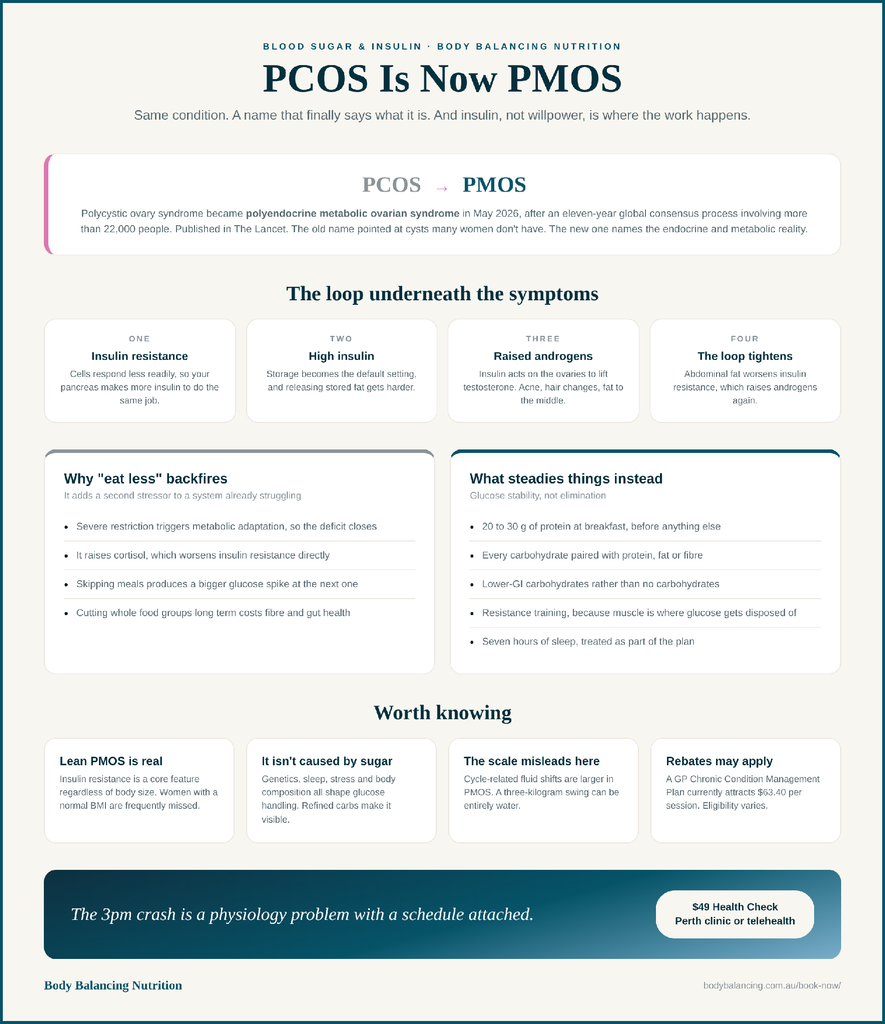
In May 2026, after an eleven-year global consensus process involving more than 22,000 people, polycystic ovary syndrome was formally renamed polyendocrine metabolic ovarian syndrome. The new name was published in The Lancet and is backed by the Endocrine Society.
The change matters clinically, not cosmetically. “Polycystic” pointed at ovarian cysts that plenty of women with the condition don’t have, which delayed diagnosis for years at a time. The new name puts the endocrine and metabolic parts of the condition in the title, where they belong.
Most people still search for and say PCOS, and your GP referral will probably say PCOS for a while yet. Both names describe the same condition. We use them interchangeably here.
What this means for you practically: if the metabolic side of your condition has never been addressed, that’s the gap. Weight, insulin and energy aren’t side effects of a reproductive problem. They’re central features of an endocrine one.
The condition affects more than 170 million people worldwide. In Australia it’s commonly cited as affecting around one in ten women of reproductive age, with higher prevalence reported among Aboriginal and Torres Strait Islander women, and a large proportion of cases still undiagnosed.
Because insulin is a storage hormone, and when it’s chronically high, storage is the setting your body is stuck on.
Insulin’s job is to move glucose out of your blood and into cells. With insulin resistance, cells respond less readily, so your pancreas produces more to get the same job done. Those high circulating levels do two things at once. They make it harder to release stored fat for fuel. And they act directly on the ovaries to increase testosterone production.
That’s the loop women describe without knowing it has a name.
| What you notice | What’s driving it |
| Weight that won’t move despite eating well | High insulin suppressing fat release, calorie surplus |
| The 3pm crash and sudden sweet cravings | Blood glucose spiking then dropping sharply |
| Adult acne, facial hair, scalp thinning | Raised androgens, driven partly by high insulin |
| Fat settling around the middle | Androgens shifting storage toward the abdomen |
| Irregular or absent periods | Hormonal disruption of ovulation |
Abdominal fat then worsens insulin resistance, which raises androgens further. The loop tightens.
Two things worth knowing. Insulin resistance is a core feature for most women with PMOS regardless of body size, so lean women get it too and are frequently missed. And it isn’t caused by eating sugar. Genetics, sleep, stress and body composition all shape how your body handles glucose. Refined carbohydrates make an existing problem more obvious rather than creating it.
Because it adds a second stressor to a system already struggling to regulate energy.
Severe restriction triggers metabolic adaptation, so your energy output falls to meet your intake and the deficit closes. It also raises cortisol, which worsens insulin resistance directly. And skipping meals to save calories may produce a larger glucose spike at the next meal, which is the opposite of the goal.
There’s a pattern we see constantly. A woman eats almost nothing until 2pm, feels virtuous, then eats continuously from 4pm because her blood glucose has been on the floor for hours. She reads that as a willpower problem. It’s a physiology problem with a schedule attached.
The keto and carnivore approaches circulating online can produce fast early results, and some women feel genuinely better on lower carbohydrate intakes. The difficulty is sustainability and the collateral damage: cutting entire food groups long term, can lead to nutrient deficiencies, affects fibre, gut health and thyroid function in some women, and the regain when the diet ends tends to arrive with more fat than was lost.
The goal is glucose stability, not carbohydrate elimination.
Works from your data instead of a template.
In Australia, Accredited Practising Dietitian is the credential recognised for medical nutrition therapy, and an APD can work directly from your bloods, your medical history and your GP’s management plan. BBN’s team includes nutritionists, clinical nutritionists and APDs, and which practitioner is right for you depends on what your presentation needs.
The practical differences look like this.
| Generic meal plan | Clinical assessment |
| Same plan for every woman with PCOS | Built around your bloods, symptoms and history |
| Fixed rules that break the first busy week | Adjusted as your markers and life change |
| Progress measured by the scale | Measured across body composition, symptoms, energy and markers together |
| No account of gut health, sleep or stress | Assessed together, because they drive insulin too |
| No clinical oversight | Reviewed by a practitioner who can escalate or refer |
The scale is a particular problem in PMOS. Fluid shifts across the cycle are larger for many women with the condition, so weekly weigh-ins produce noise that looks like failure. Body composition analysis tracks muscle and fat separately, which is the measurement that reflects what’s actually improving.
Start with breakfast, because it sets the pattern for the rest of the day.
A breakfast built on fibre, healthy fats and protein anchors your blood glucose and prevents the mid-morning drop that drives everything after it. Twenty to thirty grams of protein is the working target. Toast and coffee won’t get you there. Eggs, Greek yoghurt, or last night’s leftovers will.
From there, four things do most of the work:
Pair every carbohydrate. Carbohydrate eaten alone spikes glucose faster than the same carbohydrate eaten with protein, fat or fibre. Fruit with nuts rather than fruit alone. This is the single easiest change to make and one of the most effective.
Choose lower-GI carbohydrates rather than cutting them. Oats, legumes, grainy bread, sweet potato. Your brain and your ovaries both need glucose. The question is the speed it arrives at.
Add anti-inflammatory fats. Oily fish, walnuts, extra virgin olive oil. Systemic inflammation is part of the PMOS picture and diet influences it.
Protect your sleep. Short sleep raises ghrelin and reduces insulin sensitivity the following day. You can eat perfectly and lose to a fortnight of five-hour nights.
On supplements: inositol has reasonable evidence for improving insulin sensitivity in PMOS, and magnesium may help with sleep quality. Both are worth discussing with a practitioner who knows your bloods rather than starting from a podcast recommendation. Dose and form matter, and neither replaces the eating pattern underneath.
Movement is the other lever. Resistance training builds muscle, and muscle is where glucose gets disposed of, so it improves insulin sensitivity directly. Two or three sessions a week does more for PMOS than daily cardio.
Check the credential first, then check whether they work from data.
APD status means your practitioner is bound to evidence-based standards and can provide medical nutrition therapy. Beyond that, ask what they measure and how often they reassess. A practitioner who tracks only weight is working with one blunt number in a condition where fluid and body composition move independently.
Ask whether they’ll work alongside your GP or endocrinologist. PMOS management usually involves more than one practitioner, and the nutrition side works better when it’s connected to the medical side rather than running in parallel.
On cost: if your GP prepares a Chronic Condition Management Plan, you may be eligible for a Medicare rebate toward a limited number of allied health sessions each calendar year. The current rebate is $63.40 per session, updated when the chronic disease management arrangements were restructured. Eligibility depends on your circumstances and your GP’s assessment, so treat it as something to ask about rather than something to count on. Some services may also attract private health rebates depending on your cover.
Yes, and insulin resistance is the reason to see one rather than a reason not to. The approach shifts from cutting calories to stabilising glucose, because high insulin is what’s making stored fat hard to access. Food pairing, protein distribution and meal timing do more here than a smaller portion size.
Not unless you have a diagnosed intolerance or coeliac disease. There’s no good evidence that either food group is inherently a problem in PMOS. Cutting them without reason narrows your diet, makes eating socially harder, and often costs you fibre and calcium for no return.
Same condition, better name. The rename in May 2026 reflected a clearer understanding of PMOS as a metabolic and endocrine condition rather than a primarily ovarian one. Nutrition management was already moving in that direction, so the clinical approach hasn’t changed so much as the name caught up with it.
No, you can book privately. A referral matters only for the Medicare rebate, which requires a Chronic Condition Management Plan prepared by your GP. Plenty of women start privately and organise the plan afterwards.
Nutrition is a first-line treatment for fertility in PMOS. Improving insulin sensitivity supports more regular ovulation, and modest weight loss where relevant has measurable effects on cycle regularity. If conception is your goal, say so at the first appointment, because it changes the priorities.
More often at the start, less often as things stabilise. Fortnightly or monthly is typical through the first phase, when the plan is being adjusted against how you’re responding. Once your markers and symptoms settle, intervals stretch out.
Fluid. Cycle-related fluid shifts are larger for many women with PMOS, and glycogen storage changes with carbohydrate intake carry water with it. A three-kilogram swing across a fortnight can be entirely water. This is exactly why body composition matters more than weight here.
Lean PMOS is real and frequently missed, because the diagnostic conversation is often anchored to weight. Insulin resistance is a core feature regardless of body size. If you have irregular cycles and raised androgens with a normal BMI, the metabolic side still deserves attention.
| Point | What it means for you |
| PCOS is now PMOS | Renamed May 2026 to reflect the metabolic and endocrine reality rather than ovarian cysts |
| Insulin resistance is the engine | Core feature for most women with PMOS, whatever your body size |
| High insulin drives androgens | Which is why acne, hair changes and abdominal fat travel together |
| Glucose stability beats elimination | Pair carbohydrates with fibre and protein at every meal, choose lower-GI options |
| Resistance training improves insulin sensitivity | Muscle is where glucose gets disposed of |
| The scale is unreliable here | Fluid shifts are larger in PMOS, so body composition is the better measure |
| Rebates may apply | A GP Chronic Condition Management Plan currently attracts $63.40 per session, subject to eligibility |
When you have been managing PMOS on your own with information from six different places, it is hard to know which part of the picture to work on first. Insulin, weight, cycle and symptoms all feed each other.
That is what our $49 Health Check is for.
Every BBN client starts with a private 45-minute appointment with Maria, our owner and Health Coach. Together, you will look at your symptoms, health and weight history, sleep, energy, eating patterns, movement and what you have already tried.
At our Perth clinic, your appointment includes an InBody 570 body composition scan. This allows us to look at muscle, body fat and fluid separately, rather than averaging everything into one number.
You will leave with a clearer understanding of:
You won’t be handed a generic plan or pressured to sign up for anything. The Health Check is designed to help you understand your starting point before you spend more time, money and effort on an approach that may not fit.
Telehealth appointments include the same detailed review of your symptoms, history and priorities, without the body composition scan.
45 minutes. $49. Measure, don’t guess.
This article provides general nutrition information rather than individual clinical advice. Speak with your GP or an appropriately qualified practitioner about your own situation.
Kickstart Your Journey to Better Health with Our Balanced Health Blueprint Consult – $49 (valued at $139)