You haven’t changed anything. Same food, same walking, same effort you’ve been applying for twenty years. The middle of your body is different anyway, and you still don’t have an explanation.
“I can’t work out if this is peri or some other issue?” [r/Perimenopause, Apr 2026]. That question sits underneath most of what women bring into clinic at this stage.
Perimenopause weight gain has two separate things happening at once. The weight going on is driven mostly by ageing, muscle loss and how life changes through your forties. Where it settles is hormonal, because falling oestrogen moves fat storage toward the abdomen. Two causes, two different responses, and “eat less, move more” addresses neither properly.
What follows is what’s shifting, why the approach that worked before stopped working, and what makes a measurable difference now.
Two processes run in parallel here, and they get blamed for each other constantly.
The Australasian Menopause Society is direct about this: weight gain around menopause has more to do with ageing and lifestyle than with the hormonal changes themselves. Both men and women put on weight through this decade. What menopause does is change the storage address.
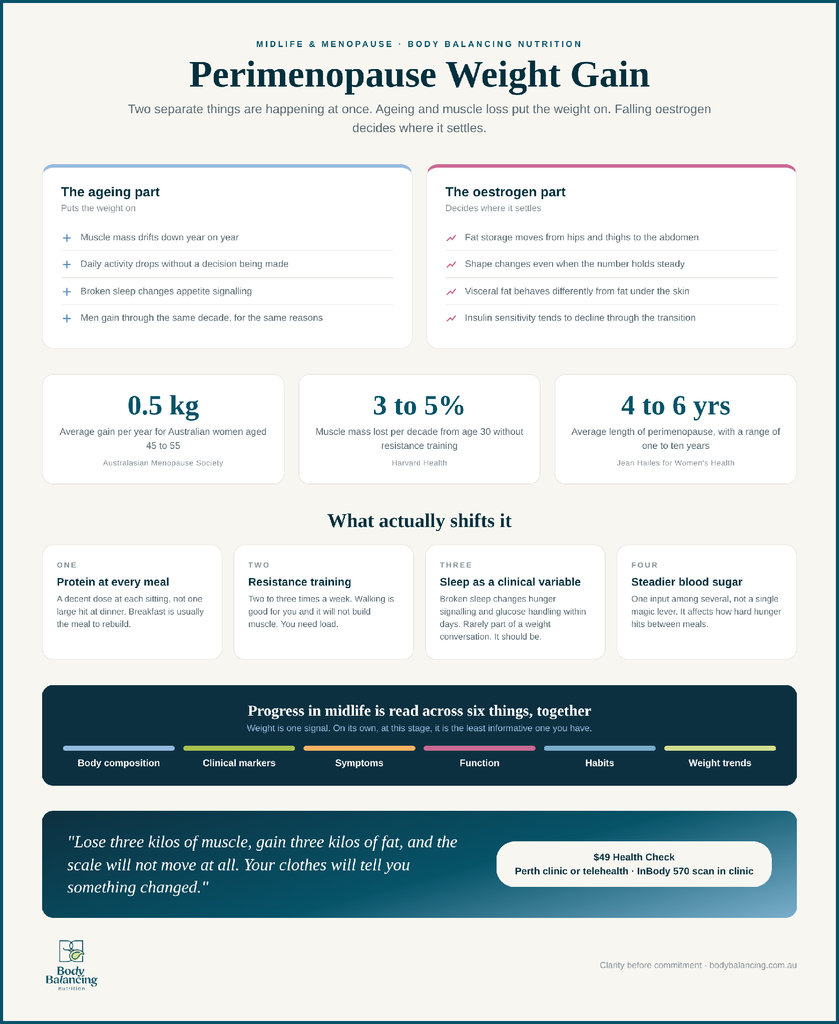
Half a kilogram a year is the average gain for Australian women between 45 and 55, according to the Australasian Menopause Society. Slow enough that you don’t notice it happening. Fast enough that it’s five kilos over a decade, and you’re standing in the change room wondering when that happened.
Nothing dramatic causes it. Muscle mass drifts down. Activity drops without anyone deciding to drop it. Sleep gets worse, so appetite regulation gets worse. Work gets heavier, kids get more expensive, parents get older, and the hour you used to spend moving becomes the hour you spend on everything else.
The hormonal part is about distribution rather than quantity.
As oestrogen falls, fat that used to sit on hips, thighs and bottom starts settling around the abdomen instead. Same woman, same weight on the scale, different shape in the mirror. Plenty of women in perimenopause describe exactly this: the number holds and the clothes stop fitting.
Where it settles matters clinically, because visceral fat sits around the organs and behaves differently from fat stored under the skin. It’s one of the reasons we measure composition rather than relying on weight.
Jean Hailes for Women’s Health puts perimenopause at four to six years on average, starting for most women in their forties, though the range runs from one year to ten. The average age of menopause in Australia is 51 to 52. So this is a long stretch of physiological change, not a switch that flips.
The infographic below sets out both causes side by side, the numbers behind them, and what shifts them.
The old approach worked because you had more muscle, better sleep and a more forgiving hormonal environment. Take those three away and the same plan produces a different result.
Cutting calories harder is the instinct, and it’s the thing most likely to make the composition problem worse, because an aggressive deficit without adequate protein and resistance training takes muscle along with fat. You lose weight. You lose the tissue that was holding your metabolic rate up. Six months later the same deficit stops working, and the obvious conclusion is that you need to cut further. Most women arrive in clinic three or four rounds into that loop.
Muscle is your most metabolically active tissue, and you start losing it well before menopause. Harvard Health reports 3 to 5 per cent per decade from age 30 onward without deliberate resistance training. Layer the menopause transition on top and you have two forces working in the same direction, quietly, for years.
What makes it hard to see is density. Muscle is denser than fat. You can lose three kilos of muscle, gain three kilos of fat, and the scale won’t move at all. Your clothes will tell you something changed. The number won’t.
So a woman can be doing everything correctly by conventional measures and still be going backwards, because the tool she’s using can’t see the thing that’s happening.
Four things carry most of the weight here, and none of them are exciting.
Protein at every meal, not just dinner. Muscle protein synthesis in midlife needs a decent dose at each sitting rather than one large hit at the end of the day. For most women this means rebuilding breakfast, which is usually the meal that’s been quietly eroded down to coffee.
Resistance training two to three times a week. Walking is good for you and it won’t build muscle. You need load. The Australasian Menopause Society recommends 300 minutes of moderate activity a week for weight management through this stage, and resistance work sits inside that, not instead of it.
Sleep, treated as a clinical variable. Broken sleep changes hunger signalling and glucose handling within days. Waking at 3am is one of the most common things women report in perimenopause, and it belongs in a weight conversation.
Steadier blood sugar. Insulin sensitivity tends to decline through the transition, which affects how your body handles carbohydrates and how hard hunger hits between meals. One input among several, rather than a single magic lever.
The one that surprises women most is the breakfast point. Twenty years of skipping it did no visible harm, and then somewhere in your forties the same habit starts costing you muscle you can’t afford to lose. It comes up in clinic constantly.
At Body Balancing Nutrition we work the whole picture through what we call the BBN Bridge: Biology (hormones, metabolic health, gut, age), Brain (beliefs, stress, identity), Body (nutrition, movement, sleep) and Behaviour (habits, environment, routine). No single lever explains every woman, which is why the appropriate practitioner assesses each one individually rather than handing out the same protocol.
Weight is one signal. On its own, in this stage, it’s the least informative one you have. What we look at instead, together:
A woman who has lost two kilos of fat and gained one kilo of muscle has had an excellent three months. Her scale says she lost one kilo. Read that number alone and she’d conclude the whole thing failed. Measure, don’t guess.
Start by finding out what’s happening, rather than choosing a plan and hoping it fits.
You want to know what your composition looks like now, what your history and habits are telling you, and where you sit in the transition. Most women have never had any of that laid out. They’ve had a blood test that came back normal and a suggestion to try harder.
If you’re in perimenopause and the usual approach has stopped landing, that’s expected. It’s information, not a verdict on your discipline.
Some change in body composition through this stage is close to universal, and gaining weight isn’t. The average half a kilogram a year is an average across a population, not a prescription. Women who maintain muscle through resistance training and adequate protein tend to hold composition far better through the transition than women who respond by eating less.
Falling oestrogen changes where your body stores fat, moving it from hips and thighs toward the abdomen. This happens even when your total weight stays stable, which is why so many women describe a shape change without a number change. It’s the most reliably hormonal part of the whole picture.
You often can’t tell from symptoms alone, and you shouldn’t have to guess. Perimenopause overlaps with thyroid issues, iron deficiency, insulin resistance and ordinary ageing, and several of them can be present at once. Your GP investigates the medical side. The nutrition, metabolic and body composition layer is what we look at, alongside them.
The Australasian Menopause Society states that menopausal hormone therapy doesn’t cause weight gain, and that it can reduce the abdominal fat associated with menopause. Prescribing decisions sit with your doctor. What we do is the nutrition and body composition side, whether or not you’re on it.
Cutting harder is the most common response and it tends to make the composition problem worse, because an aggressive deficit without enough protein and resistance training takes muscle with the fat. Getting the composition right usually matters more than getting the calories lower.
Worth investigating properly rather than pushing harder into the same approach. Weight can stay flat while composition improves, and it can stay flat for reasons that have nothing to do with effort. Composition data, symptoms, energy and function together tell you far more than the number does on its own.
When your body changes through perimenopause and the approach that used to work stops working, it is difficult to tell which part of it is hormonal, which part is ageing and muscle, and which part is something else entirely. From the outside they look the same.
That is what our $49 Health Check is for.
Every BBN client starts with a private 45-minute appointment with Maria, our owner and Health Coach. Together, you will look at your symptoms, health and weight history, sleep, energy, eating patterns, movement and what you have already tried.
At our Perth clinic, your appointment includes an InBody 570 body composition scan. This allows us to look at muscle, body fat and fluid separately, rather than averaging everything into one number.
You will leave with a clearer understanding of:
You won’t be handed a generic plan or pressured to sign up for anything. The Health Check is designed to help you understand your starting point before you spend more time, money and effort on an approach that may not fit.
Telehealth appointments include the same detailed review of your symptoms, history and priorities, without the body composition scan.
45 minutes. $49. Measure, don’t guess.
This article provides general nutrition information rather than individual clinical advice. Speak with your GP or an appropriately qualified practitioner about your own situation.
Kickstart Your Journey to Better Health with Our Balanced Health Blueprint Consult – $49 (valued at $139)